
Trusting the Dance
What has always been true: Life has a mind of its own

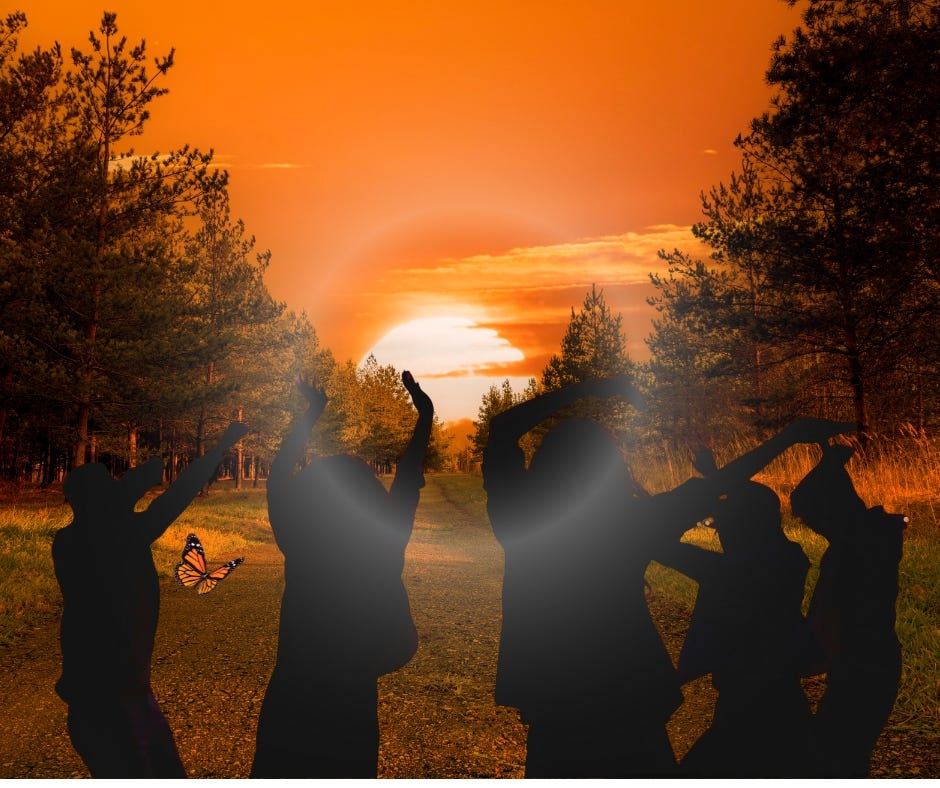
Why is it that we consistently forget life is a collaboration with the Divine, not a personal directive? We build our calendars, our five-year plans, our carefully worded intentions, and somewhere underneath all that scaffolding we start to believe we’re the ones in charge. Then a phone call comes. A door closes that we were certain would open. Someone we loved leaves, or stays longer than we thought they would, and the whole structure we built our certainty on starts to wobble.
I’ve lived long enough now and watched enough people I love move through their own unravelings to know this isn’t a flaw in the design. It IS the design.
There’s a difference between control and trust that most of us were never taught. Control suggests I will determine the outcome. I will manage every variable until the result matches the picture in my head. Trust says something else entirely. Trust says: I don’t know what’s coming, and I’m going to move anyway. Sometimes recklessly. Fewer times without discernment. And as often as possible with a confidence that doesn’t require certainty to keep walking.
The dance metaphor works well here. A dancer who tries to control every muscle, every beat, every shift of weight before it happens will dance badly. She’ll be a half second behind herself, always catching up to a moment that’s already passed. But a dancer who’s trained her body and then lets the music move through her, who trusts the floor to hold her weight and her partner to be where he says he’ll be, dances like something sacred or superhuman is moving her. It’s a form of surrender to a partnership with forces bigger than any single will, including her own.
This is what I mean when I say life has a mind of its own. Life is in relationship with us, responding to our choices the way a partner responds to a lead, but never simply obeying. It has its own intelligence, its own sense of timing, its own ideas about what we actually need versus what we asked for. The people who suffer most, in my experience, aren’t the ones who face hardship. They’re the ones who refuse to stop fighting the fact that hardship arrived, instead of leaning into what it’s there to teach.
I remember how I spent years resisting a divorce that life had clearly already initiated, fighting for a marriage that had become loud and uncomfortable long before either of us said the word out loud. I held the form of the thing long after its substance had gone, the way you might keep watering a plant that’s already given everything it had to give. I told myself I was being faithful. What I was actually feeling was fear. I was afraid that if I stopped fighting for the marriage, I’d have to face what was waiting on the other side of it, and I had no idea yet what that was.
I think too of the years I held so tightly to a career identity that I almost missed the calling trying to get my attention. I had built something I was proud of, something that made sense on paper and helped me relax a little when I introduced myself at parties. Letting it go felt like letting go of who I was, not just what I did. It took the ground shifting out from under me, more than once, before I understood that the identity and the calling were never actually the same thing. The career had been a vessel. I had mistaken it for the water. I’m sure you have similar stories of your own.
None of us was wrong to want what we wanted. The marriage, the title, the version of the future we’d already rehearsed in our minds. But the wanting, held that tightly, can become its own kind of suffering. The moment we loosen our grip, even slightly, even with our fists still half closed, something in us exhales.
That exhale is what trust actually feels like. It’s not peaceful. It’s relief.
I want to be precise about what I’m not saying. I’m not saying to let go of your desires. I’m not saying stop making plans, stop showing up to your own life with intention and effort and skin in the game. The dance still requires a dancer. It still requires training, presence, and the willingness to fall down and get back up. What I’m saying is that the outcome was never fully yours to dictate, and the sooner you make peace with that, the sooner you can actually enjoy the music instead of fighting it.
We are in collaboration with Divine forces. We have free will, and that free will matters enormously: it’s the difference between sleepwalking through your life and actually choosing to show up for it. But free will was never meant to mean we walk alone. It means we get a say in the conversation. It doesn’t mean we get the only say. Life still answers back, in its own language, on its own timeline, and most of us spend a great deal of our lives learning to recognize that language and trust what it’s telling us.
Here’s what I’ve come to believe, after thirty-five years of watching this pattern play out in my own life and in the lives of people I’ve had the privilege to walk beside. The moments we remember as turning points, the ones that actually changed us, were rarely the moments we planned. They were the moments life took the lead, and we, terrified or exhausted or simply out of other options, let go and followed.
That’s not weakness. That’s wisdom arriving the hard way, which is usually the way it arrives.
There’s a particular grace available to the people who learn this early, but I want to say clearly: most of us don’t. Most of us learn it the way I did, by holding on long past the point of usefulness, by mistaking grip strength for faith. If that’s where you are right now, just notice how it feels. You’re in the part of the dance where you’re learning the steps by getting them wrong first. That part is crucial. It might be the most important aspect of the entire dance.
So if you’re standing at the edge of something right now, uncertain whether to push forward with the plan you made or release your grip on a future that no longer seems to want you in the same way you wanted it, I’d offer you this:
Life has a mind of its own. It always has. The question isn’t whether you can control where it’s leading you. The question is whether you trust the one leading enough to let your feet move before you fully understand the steps.
That’s the dance. That has always been the dance.
This is beautiful and just what I needed today. I do feel like I am standing at the door of the unknown - alone with no idea of where this is going. The reminder I got in meditation this am and now again in the timely post reminds me I do not create alone and surrendering right now is a good thing to do.. So thank you for being such a voice of beauty in the world.
I love this Ahriana. One of the things that I love about your writing is that it does not sound like AI was involved. It sounds like it's coming straight from your heart. Thank you for that - so many substack authors have succumbed to AI writing, and it's obvious.
Also, one of the gifts of the pandemic was that I was forced to learn how to be ok in the unknown. That was definitely a gift that benefits me every single day. Being ok with the living in the unknown.